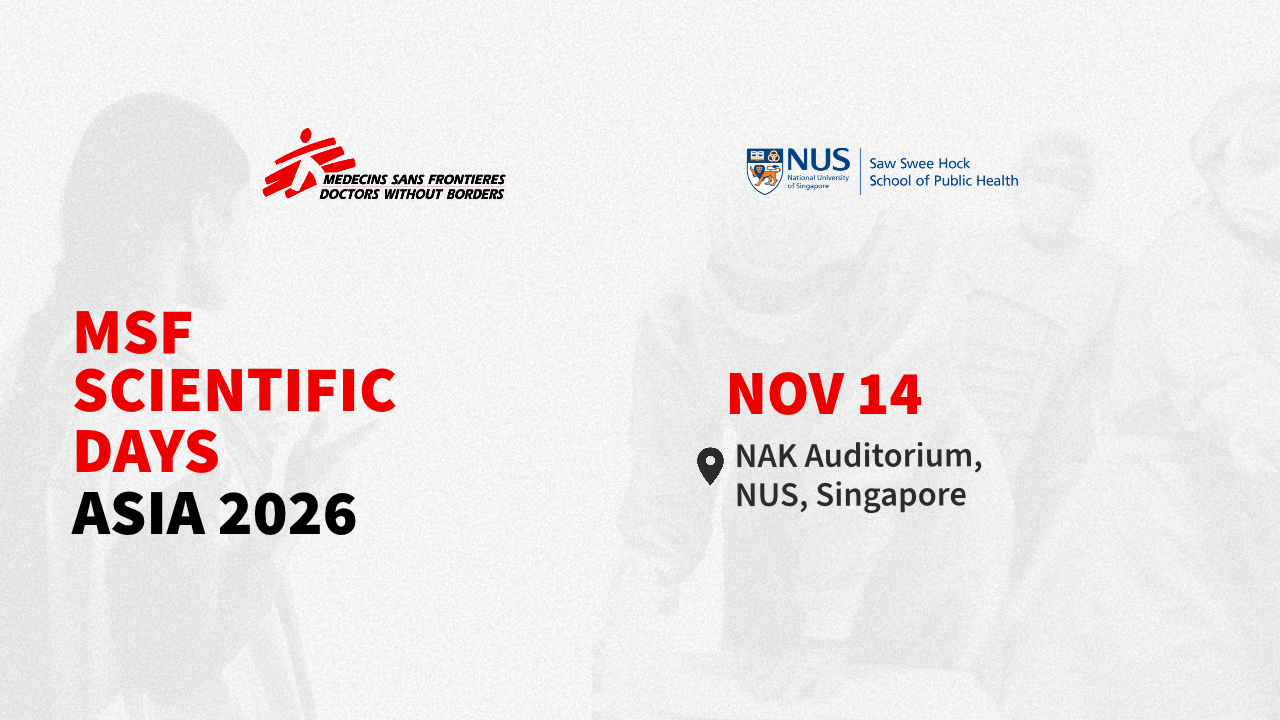
MSF Scientific Days – Asia 2026

MSF Scientific Days – Asia 2026 has evolved into a key regional platform for showcasing research, innovation, and field-based experiences across humanitarian and public health settings. The event brings together researchers, frontline responders, academics, policymakers, and community partners to advance evidence-based improvements in care for populations affected by crises and health inequities. 

Building on the success of previous editions, the 2026 conference will be hosted in Southeast Asia for the first time, reflecting MSF’s commitment to strengthening regional collaboration, operational learning, and locally grounded research. 

The event is co-organised by MSF South Asia and MSFHKF, in collaboration with MSF Access Asia Pacific and MSF Korea, with the National University of Singapore (NUS) Saw Swee Hock School of Public Health serving as the academic partner. NUS SSHSPH is a leading institution in Asia for research, education, and policy engagement in global and population health. 

Rooted in the principles of independence, impartiality, and témoignage (bearing witness), MSF Scientific Days Asia promotes critical dialogue, scientific rigor, inclusivity, and the translation of knowledge into action. The 2026 edition will focus on complex and interconnected health challenges, with an emphasis on equity, operational relevance, and access to care in resource-constrained and crisis-affected settings. 

Thematic Streams 
  1. Decision-Making, Ethics, Equity, Rights, and Humanitarian Practice

Exploring ethical and operational challenges in delivering healthcare in challenged settings, focusing on equity, prioritization, access barriers, and quality of care under constraint. Includes ethical use of AI and digital tools in clinical and operational decision-making and their implications for equity and accountability in low-resource contexts  

Focus:  
How decisions are made under constraint, and who benefits or gets excluded.  

Topics may include: 

  • Clinical and operational prioritization under scarcity 
  • Equity and access to healthcare 
  • Rights-based approaches in humanitarian settings 
  • Ethical use of AI and digital health tools 
  • Accountability in high-risk environments 
  1. Models of Care and Health System Delivery

Examining innovative and sustainable healthcare delivery approaches in fragile, urban, informal, and protracted crisis settings. The stream also covers ageing populations, geriatric care, non-communicable diseases (NCDs), sexual and reproductive health (SRHR), digital health, AI-enabled care, health financing, and equitable UHC, with emphasis on integrated and resilient systems.  

Focus:  
How care is actually delivered when systems are weak, fragmented, or collapsing.  

Topics may include:  

  • Community-based and decentralized care models   
  • Urban, informal, and hard-to-reach settings   
  • Continuity of care in protracted crises   
  • Partnerships (including Community Based Organizations)   
  • Integrated service delivery across conditions (Non Communicable diseases, Sexual and Reproductive Health, ageing populations)   
  • Health financing and pathways toward equitable Universal Health Care.  
  1. Climate, Crisis, and Health Access

Explore the intersection of climate change, humanitarian crises, and access to healthcare in vulnerable settings.  

Focus:  
Direct and indirect health impacts of climate change and environmental degradation.  

Topics may include:  

  • Vector and Water borne climate sensitive diseases (e.g., dengue)   
  • Heat and Pollution related morbidities (e.g. Heat stress, Respiratory diseases)  
  • Nutrition and WASH in climate-affected settings   
  • Sexual and Reproductive health under climate stress   
  • Climate, Environment and Health- Adaptation  
  • Environmental and spatial epidemiology and data integration.  
  1. Infectious Diseases, AMR, and Outbreak Response

Addressing evolving communicable disease burdens and response strategies. 

Focus:  
Detection, treatment, and control of communicable diseases.  

Topics may include:  

  • Vaccine-preventable diseases   
  • HIV, TB (including paediatric TB)   
  • Neglected tropical diseases   
  • Antimicrobial resistance (AMR)   
  • Outbreak preparedness and response   
  • Diagnostics and surveillance innovations (including genomics)  
  1. Mobility, Migration, and Cross-Border Health

Highlighting challenges and solutions for mobile and displaced populations.  
Includes refugee and migrant health, continuity of care, surveillance gaps, cross border collaborations and service delivery in informal or transient settings.  

Focus:  
Health systems access and moving population.  

Topics May include:  

  • Refugee and migrant health   
  • Cross-border care continuity   
  • Service delivery in transient/informal settings   
  • Surveillance and access gaps in mobile populations   
  • Legal, policy, and operational barriers  
Abstract Requirements 
  • We invite submissions that present original, evidence-based contributions to knowledge and practice. This includes, but is not limited to, traditional research, programmatic evidence, implementation experiences, analytical work grounded in real-world data and practice-based innovations. 
  • All abstracts must be submitted in English. 
  • Abstracts should follow the prescribed abstract template and formatting instructions. 
  • Abstracts must be written in one paragraph with a maximum of 400 words. 
  • The title of the abstract must be in bold, Times New Roman, 12 pt, and left justified. Must not contain abbreviations. Must clearly reflect the content of the abstract. 
  • The author’s name must be listed below the title as: Surname followed by initials (e.g., Silva JM, Perera TH) in italics. Must not include prefixes such as Dr. or Prof. The presenting author’s name must be underlined. Superscript numbering must be used after each author’s name to indicate affiliations. 
  • The affiliations of the authors must be listed below the author’s names. Must include department/division (if applicable), institution, city, and country. Affiliation numbers must correspond to the superscript numbers provided after each author’s name. 
  • Acronyms should be written in full upon first mention, followed by the abbreviation in parentheses. 
  • Use SI units where applicable. 
  • Do not include citations or references. 
  • Include up to five (5) keywords. 
  • Submissions must be original and not under consideration elsewhere. 
  • Authors are strongly encouraged to proofread submissions for grammar, spelling, formatting, and scientific accuracy before submission. 

Formatting Instructions 

  • Paper size: A4 (210 × 297 mm), Portrait 
  • Margins: 1inch all sides 
  • Font: Times New Roman, 12 pt 
  • Line spacing: Single (1.0) 
  • Layout: One-column text 
Submission Process 

All abstracts must be submitted through the official MSF Scientific Days Asia 2026 submission portal. 

Abstract Submission Deadline20 June 2026 

Selected abstracts will be reviewed by the Editorial Committee. Only accepted submissions will be invited for presentation during MSF Scientific Days Asia 2026. 

We encourage submissions from humanitarian practitioners, researchers, clinicians, students, policymakers, civil society organizations, community- led organizations and frontline actors advancing health, wellbeing, resilience, and access to care in challenging settings across Asia and beyond. 

Join us in advancing evidence-informed humanitarian action through collaboration, innovation, and shared learning. 
Other events

Show Buttons
Share On Facebook
Share On Twitter
Share On Linkedin
Contact us
Hide Buttons