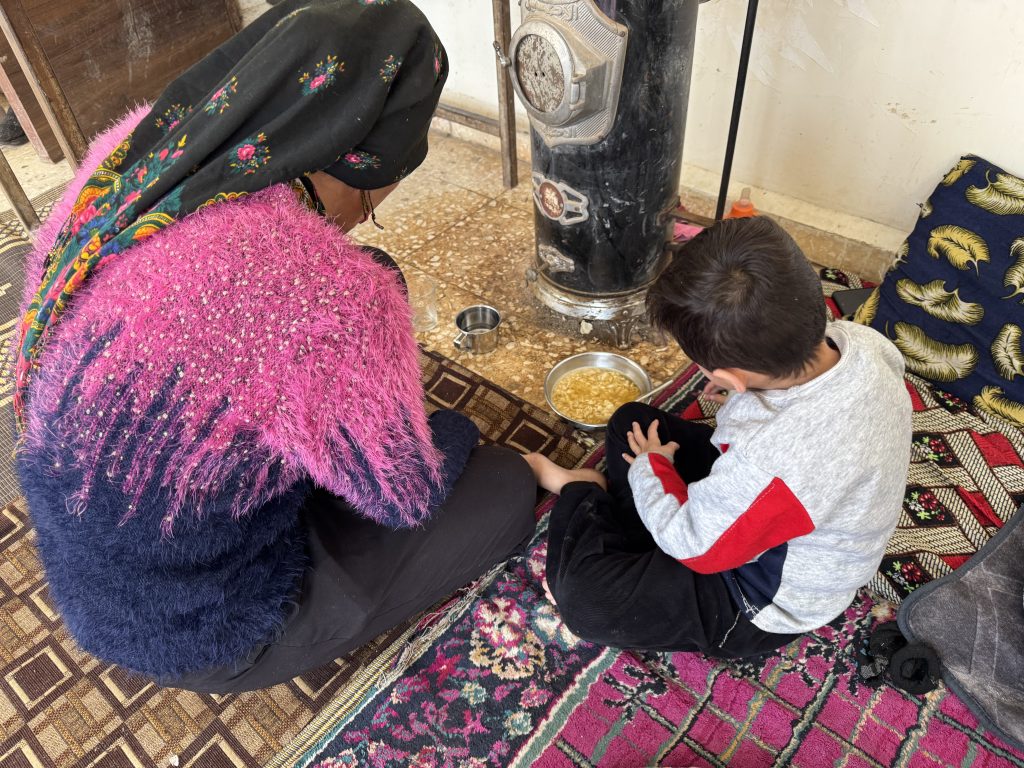
Fourteen years of conflict have left Syria deeply scarred, and for many people in the northeast, displacement continues to shape daily life. One year after the fall of the previous government, renewed fighting in mid-January 2026 displaced tens of thousands of people, overwhelming already stretched shelters and health services.
On 17 January, the Syrian Democratic Forces announced their withdrawal from Deir Hafer and Maskana in eastern Aleppo countryside. Shortly after, the Syrian Arab Army declared control over both towns and advanced into parts of Raqqa, Deir ez Zor, and Hassakeh. Clashes in areas previously held by the Syrian Democratic Forces triggered widespread civilian displacement.
Hospitals under pressure
The fighting quickly overwhelmed hospitals. During the peak violence on 18 and 19 January, the MSF-supported Deir ez Zor National Hospital received more than 100 wounded patients in just two days.
MSF teams supported emergency trauma care and donated surgical and anaesthesia kits, along with essential medications, to Deir ez Zor and Raqqa national hospitals, working closely with local health authorities to respond to urgent needs.
Shelters stretched beyond capacity
As violence spread, many displaced families sought safety in Qamishli, Hassakeh governorate. Exposed to freezing winter conditions along the route, they arrived to Qamishli with only carrying only a few personal belongings with them. The International Organisation for Migration (IOM) estimated that as of 4 February there were 94,051 people displaced in Al-Hassakeh governorate. The sudden influx has put immense pressure on basic services.
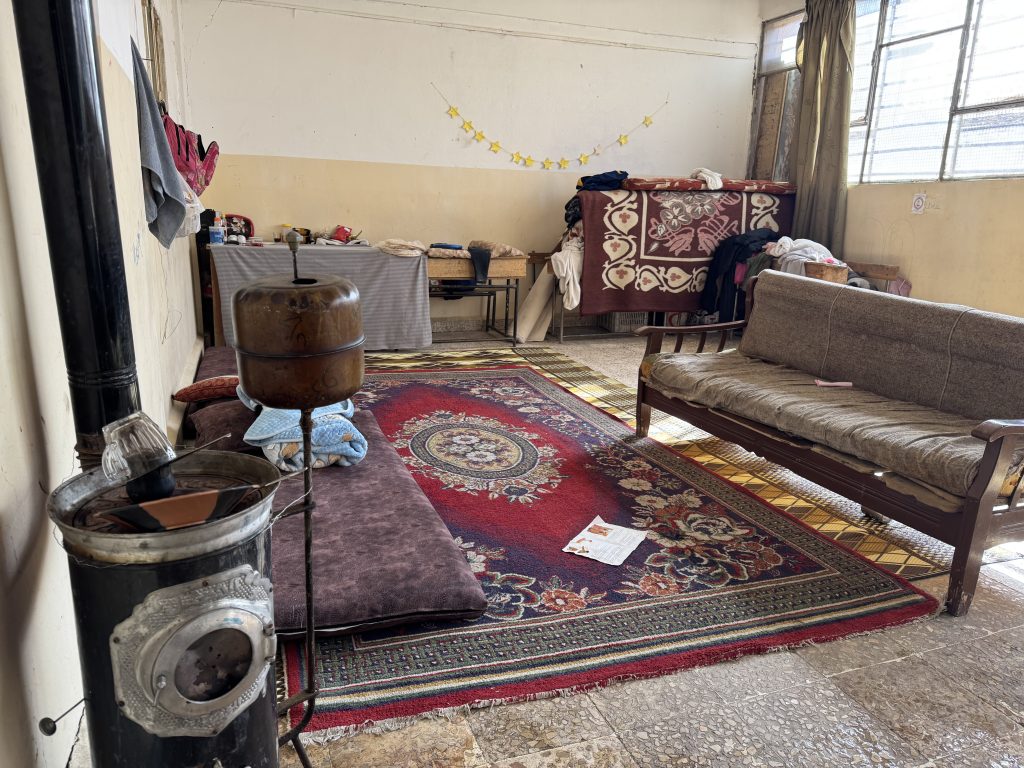
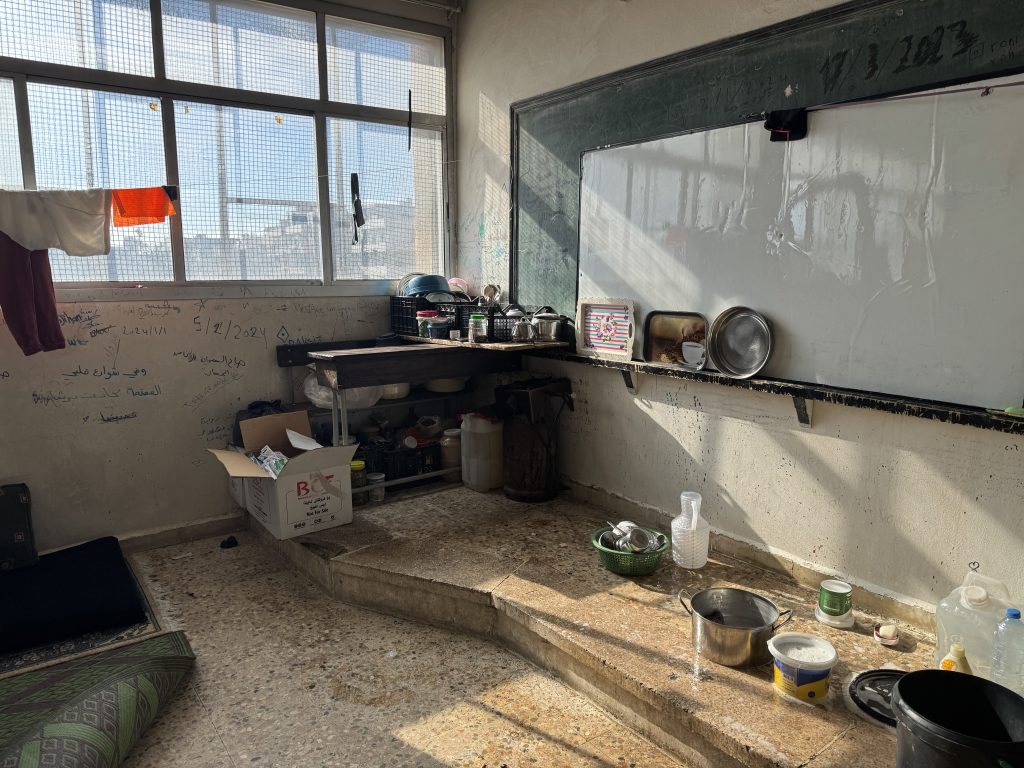
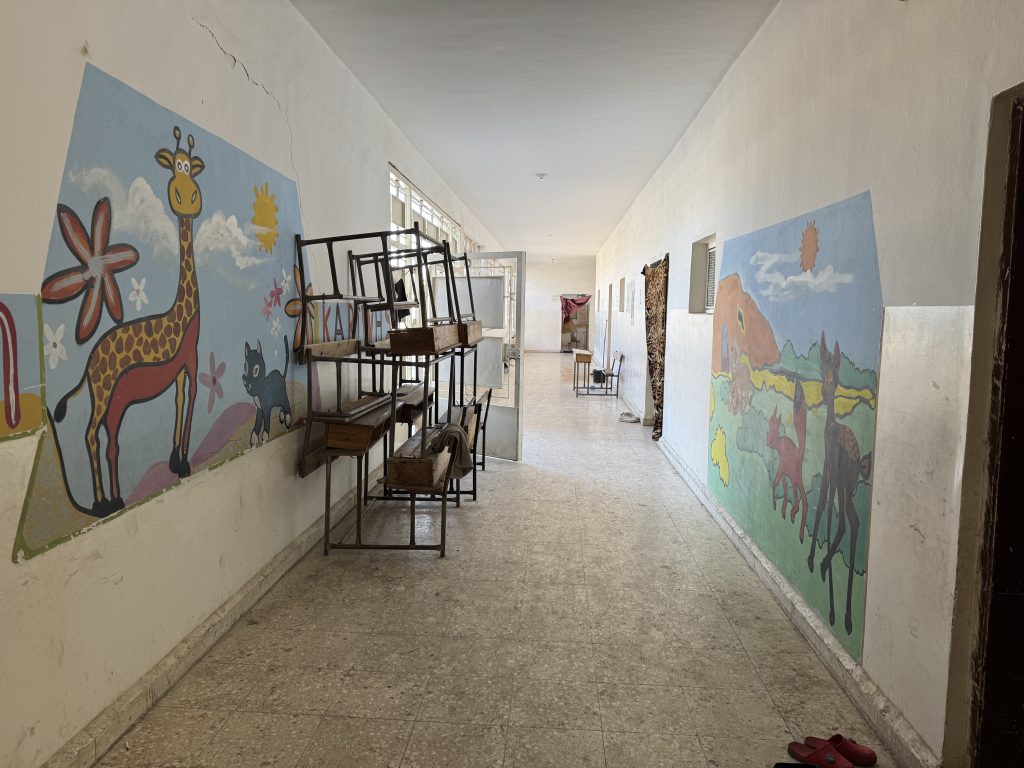
Many shelters are former schools, often poorly maintained. Upon arriving in Qamishli, MSF team visited two schools that had been repurposed into shelters. The buildings suffered from years of neglect, with peeling walls, damaged or dysfunctional toilets, and little insulation from the cold. Clothes belonging to displaced people were hung along the windows and walls to dry. During the first days of displacement, temperatures fell below 0°C, leaving families struggling to stay warm.
Many people sheltering in Qamishli have been displaced multiple times over the years. “I am originally from Afrin. Our life was normal, like any other family. We had livestock, and we were financially stable,” says Hevin Misto, a young woman and former Kurdish teacher. “That changed when Turkey’s incursion into Afrin happened in 2018.”
Hevin describes fleeing her home and hiding in a cave before reaching Shahba <area north of Aleppo>. “In Shahba, we tried to build a new life, and I started my career as a Kurdish teacher. We have stayed in Shahba for 7 years,” she says. “But in late 2024, violence came again. We were displaced to Raqqa after attacks on Tal Rifaat and Shahba.”
Hevin’s family spent a year sheltering in a school in Raqqa before being forced to flee again. “Now we are here in Qamishli,” she says.
The humanitarian efforts in northeast Syria were already under pressure due to repeated funding cuts. Now, the recent surge in forced displacement has made the situation even worse, overwhelming an already
fragile system, and making it even harder for thousands of people to get basic services such as healthcare, clean water, and sanitation.
Layla Tobal, mother of five-year-old Rashid, describes fleeing Raqqa with almost nothing. Originally from Afrin, this is the third time her family has been displaced.
While we were in Raqqa, we heard clashes and shootings. We fled only with the clothes we were wearing. Here in Qamishli, we have nothing. My son, Rashid, suffers from epilepsy and we struggle to get him the required medications. My husband and I are both sick because of the cold. Most days, our heater does not work because there is no fuel. We need clothes, blankets, and fuel. Many families here also urgently need infant milk.
Layla Tobal
Mother of five-year-old Rashid
The most vulnerable at risk
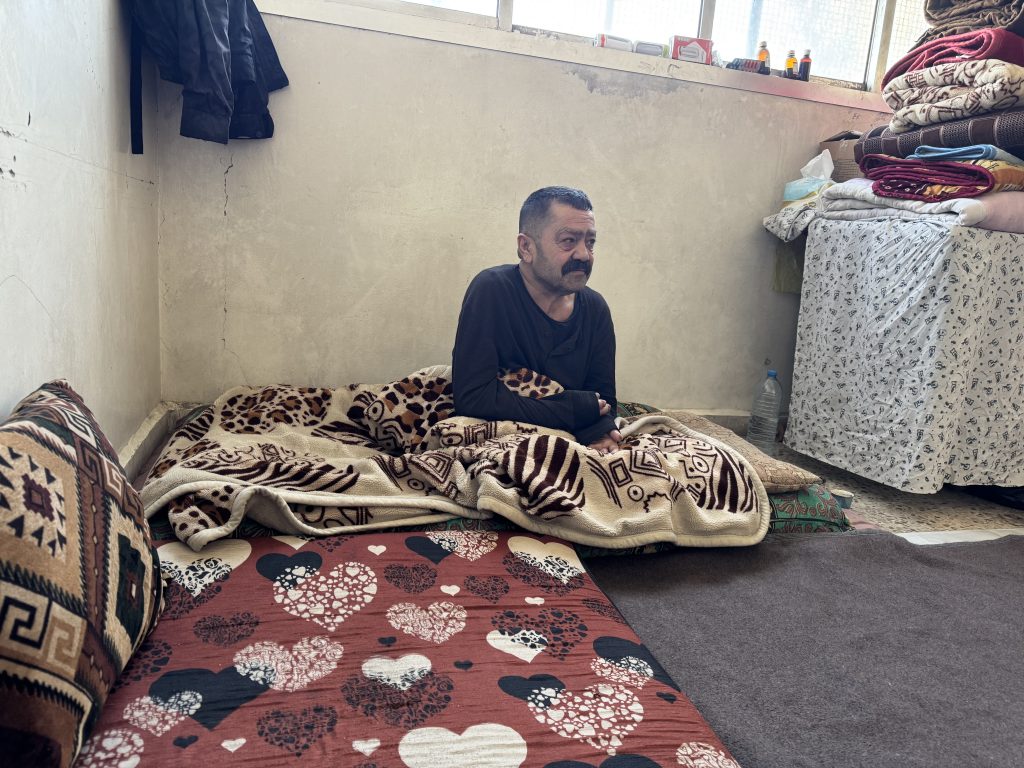
Conditions are especially harsh for people with chronic illnesses or disabilities. In one of the school rooms, we met a middle-aged man under a blanket. Younis Mouhammad lost both legs due to complications from diabetes.
“I lost my first leg in 2019 and the other one in 2022,” Younis says. “I used to work in construction, but now I am not able to do anything”.
“We need urgent support,” he says. “There are 28 families living in this school and all of them need care and assistance”.
To help displaced people, MSF medical teams are running mobile clinics in Qamishli and Derik/Al Malikiyah, providing consultations, treatment for acute and chronic conditions to ensure displaced people can access essential healthcare. More than 1320 patients have already received care.
MSF teams also distributed around 2000 mattresses, over 3220 blankets, 530 hygiene kits, hot meals, and kitchen utensils kits across more than 30 shelters in Derik/Al Malikiyah, Hassakeh and Qamishli, reaching over 330 families.
MSF water and sanitation teams truck clean water in and repair infrastructure like toilets, pipes, taps, and water tanks in shelters, ensuring displaced people have safe water to use.
“People who have been forced to flee again and again just want to be able to live in safety and with dignity. All efforts must be made to ensure they are able to do so,” says Barbara Hessel, head of MSF programmes.
“My dream is that we have a stable life, without moving from one place to another,” says Layla. “We just want to live without fear.”
Like many websites, MSF uses cookies to enhance your user experience. By continuing to navigate this site you are giving consent to the issue of these cookies. No, give me more info
This website uses cookies to improve your experience while you navigate through the website. Out of these cookies, the cookies that are categorized as necessary are stored on your browser as they are essential for the working of basic functionalities of the website. We also use third-party cookies that help us analyze and understand how you use this website. These cookies will be stored in your browser only with your consent. You also have the option to opt-out of these cookies. But opting out of some of these cookies may have an effect on your browsing experience.
Necessary cookies are absolutely essential for the website to function properly. This category only includes cookies that ensures basic functionalities and security features of the website. These cookies do not store any personal information.
Any cookies that may not be particularly necessary for the website to function and is used specifically to collect user personal data via analytics, ads, other embedded contents are termed as non-necessary cookies. It is mandatory to procure user consent prior to running these cookies on your website.