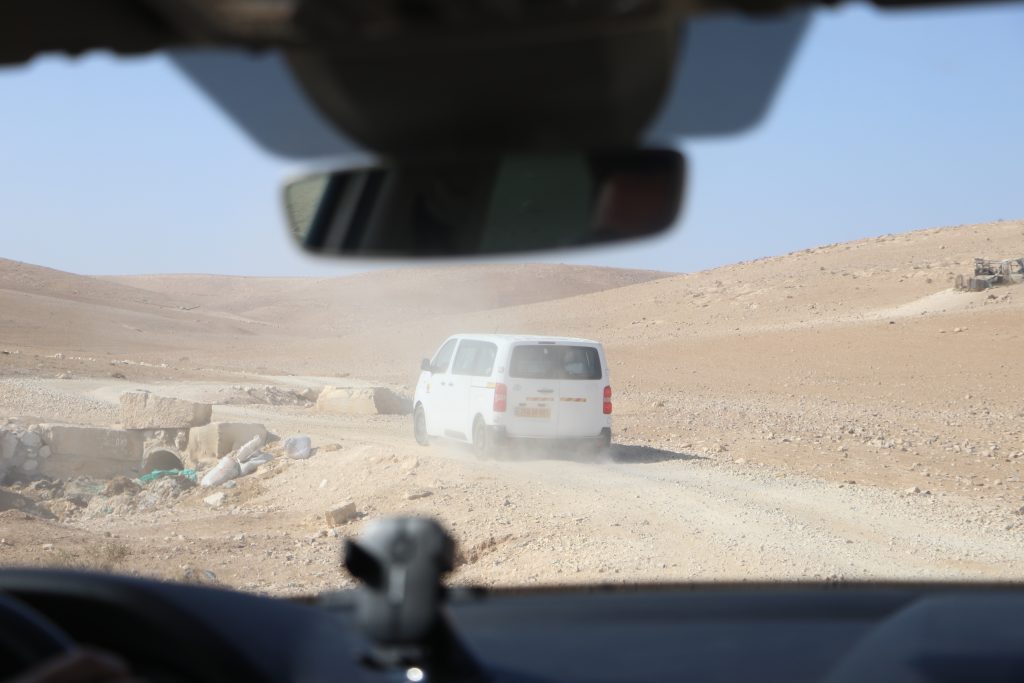
“Palestinians are preparing themselves for loss”- By a psychologist working with Médecins Sans Frontières (MSF), who requested anonymity.
While violence may not be new in the West Bank, Palestine, everything intensified after 7 October 2023. We’ve seen a sharp escalation: checkpoints, roadblocks, and incursions by the Israeli forces and settlers have cut Palestinian towns and villages from each other. These restrictions are blocking Palestinians from being able to access to basic services, such as healthcare, food markets and schools.
As an MSF psychologist working in Hebron, I can see and feel how people’s fear continues to increase. Fear is everywhere and this time it is paralysing people. Palestinians aren’t just worried: they’re preparing themselves for loss. Our patients often tell us that when they see images of people in Gaza collecting the remains of their loved ones, they cannot help but think: “If I die, I want to die with my family”. These aren’t abstract thoughts. These are ways for the mind to make sense of the horrors. Instead of planning for their own or their children’s future, many are focusing on imagining the least painful way to die. A death that comes at once, and one that spares anyone from being left behind.
In the West Bank, there is a growing sense that something terrible is coming, but no one knows exactly when or how. It’s a collective awareness, a quiet, ever-present anxiety. People say it openly: “They started in Gaza. Then they moved to the north of the West Bank. Now it’s just a matter of time until it’s our turn”. Whether you’re a mental health professional or a farmer, we all feel it. We’re all waiting for our turn.
In our clinics, we can see a noticeable increase in symptoms of depression, anxiety, and post-traumatic depression. The symptoms vary, but the patterns are clear. Men, especially those who have lost their sources of income, are showing more psychosomatic symptoms. It’s more socially acceptable to say, “my stomach hurts” than “I’m scared”. But fear and despair are the root causes of their expressions: fear is in their eyes.
Mothers share terrifying thoughts with us. When they imagine a potential settler attack, their minds race to ensure no one is left behind. One mother told me: “Every time I think it might happen, I keep repeating to myself: I must take all my children. I can’t forget anyone”.
Palestinians are so overwhelmed that even when MSF mobile clinics come close to them, many are too scared to come. The terror of crossing checkpoints outweighs their need for medical help, both mental or physical. Their decision to stay home isn’t out of indifference, it’s fear.
There’s a widespread belief that settlers or soldiers could enter at any moment, simply because someone posted on Facebook or spoke with a neighbour. This time, roads home are being raided and the way Palestinians are arrested by Israeli forces are deeply humiliating. There are no rules. It creates a constant state of readiness in people: a readiness to flee, to be displaced, or to be arrested. That anticipation is feeding the anxiety we see in nearly every patient.
This is not a temporary crisis. It’s a long, grinding generational trauma that Palestinians in the West Bank are being forced to live through, day by day. And in that slow erosion of safety, dignity, and hope, mental health suffers quietly, but profoundly.
Like many websites, MSF uses cookies to enhance your user experience. By continuing to navigate this site you are giving consent to the issue of these cookies. No, give me more info
This website uses cookies to improve your experience while you navigate through the website. Out of these cookies, the cookies that are categorized as necessary are stored on your browser as they are essential for the working of basic functionalities of the website. We also use third-party cookies that help us analyze and understand how you use this website. These cookies will be stored in your browser only with your consent. You also have the option to opt-out of these cookies. But opting out of some of these cookies may have an effect on your browsing experience.
Necessary cookies are absolutely essential for the website to function properly. This category only includes cookies that ensures basic functionalities and security features of the website. These cookies do not store any personal information.
Any cookies that may not be particularly necessary for the website to function and is used specifically to collect user personal data via analytics, ads, other embedded contents are termed as non-necessary cookies. It is mandatory to procure user consent prior to running these cookies on your website.