

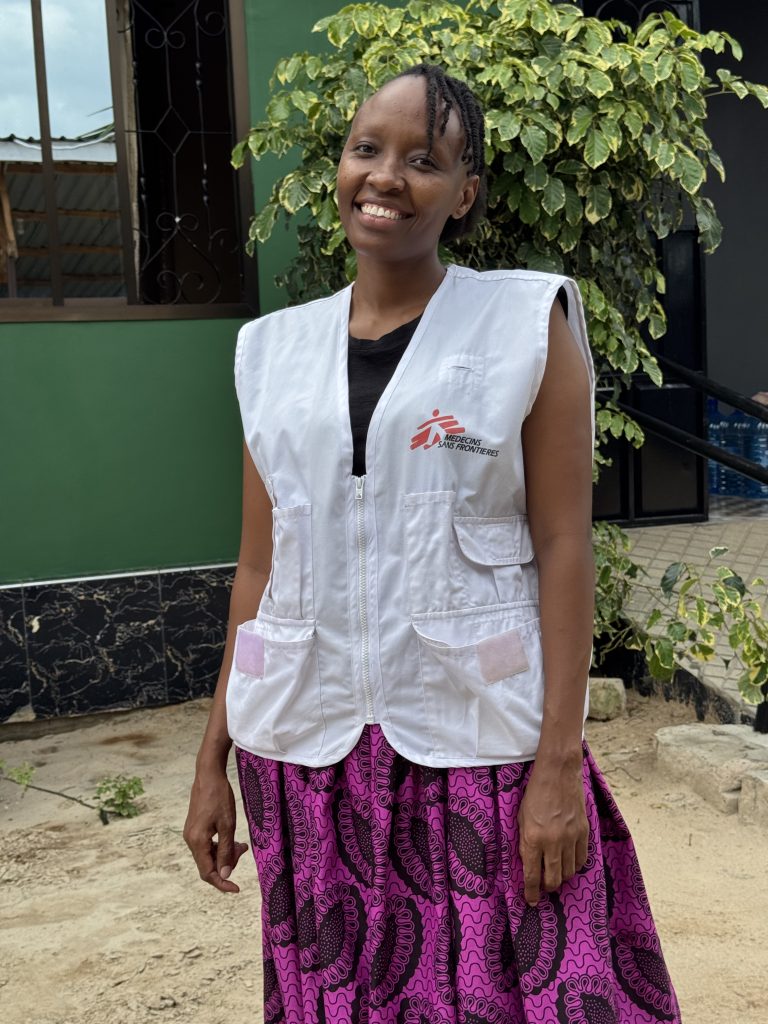
By Jackline John, Medical Interpreter, MSF Tanzania
In the heart of Liwale, where the red dust of the Lindi Region settles on every surface, silence can be a dangerous symptom. Here, at the District Hospital, a woman’s life often hangs on a terrifying paradox: she is surrounded by medical expertise, yet she is trapped in a vacuum of silence because she cannot understand the language of her own cure. My name is Jackline John, and I am an MSF medical interpreter. My role is to translate the patient’s words for the English-speaking medical team and vice versa. While I am trained as a Water Supply and Sanitation Technician, I have learned that medicine, no matter how advanced, cannot heal what it cannot reach.
By bridging the gap between English-speaking doctors and Swahili-speaking mothers, I ensure that no woman has to face the threshold of life and death feeling like a stranger in her own delivery room. As an MSF interpreter, I have learned that a doctor’s skill and a hospital’s technology are only as powerful as the patient’s ability to understand them. I am the bridge between two worlds: the complex English of international medicine and the soft Swahili of a mother in labor who is terrified because she cannot understand the people trying to save her life. In this rural corner of Tanzania, where the distance to care is measured in long, dusty miles and cultural shadows, my voice is more than just a translation; it is a lifeline of dignity, ensuring that no woman is left a stranger to her own healing.
The transition from technician to the frontlines of humanitarian aid was driven by a single conviction: healthcare is not just a clinical transaction; it is a human connection. After becoming a certified Swahili interpreter through the National Council for Kiswahili Tanzania, I joined MSF in February 2025. My job is to harmonize communication between our patients and the medical team.
My day usually begins in the bustle of the morning ward rounds. I walk alongside a collaborative team MSF gynecologists, pediatricians, and midwives who work hand-in-hand with our Tanzanian national medical team. As we move from bed to bed, I am the vital link. While the national staff are often stretched thin, managing a high volume of patients and the heavy burden of medical documentation, my presence allows the MSF doctors to communicate directly and deeply with the patients. This direct line of communication is essential; it ensures the MSF team gathers complete and accurate information firsthand, saving precious time for the national staff while allowing for a more intimate and precise consultation. We visit pregnant women, mothers recovering from surgery, and those whose tiny infants are fighting for life in the Neonatal Intensive Care Unit (NICU).
On the surface, my job is to translate words. In reality, I am translating trust. The patients I work with are often from remote villages; many have never interacted with a foreign doctor. Seeing a “Mzungu” (white person) in a white coat can be intimidating. I watch their faces closely. I see the flash of fear or the tight set of a jaw. Before the medical consultation even begins, I step in to facilitate the most important cultural bridge: the greeting. In our culture, a greeting is a sign of respect and humanity. I guide the medical team on how to address an elder versus a younger mother. These small gestures melt the ice, allowing the clinical work to begin in an environment of safety.
In the labor room, the atmosphere is often tense. I remember a day when a woman was referred to us in critical condition. The room was a whirlwind of activity; the gynecologist and nurses were moving with frantic precision to save her life. The patient was panicking, crying out, and thrashing in pain. She couldn’t understand the rapid English instructions being exchanged over her.
Because I wasn’t performing a clinical task, I was able to be her anchor. I leaned in and spoke slowly in Swahili, calming her spirit while interpreting the doctor’s vital instructions. “Breathe with me,” I told her. “The doctor needs you to lie still so he can help you.” In that moment, the panic subsided. She relaxed, the procedure was completed, and a life was saved. That is the essence of my work. Without an interpreter, doctors are often forced to rely on busy national staff who have their own clinical duties. This creates delays and “broken telephone” moments. My presence ensures the doctor has the full picture and the patient has a voice.
Liwale is vast, and the challenges here are deeply tied to the land. Many women work on distant farms and must travel long distances, often over roads that become impassable during the rainy season. When MSF arrived, we had to earn the community’s confidence. Being a local interpreter helps build that bridge. When a mother sees me, someone who speaks her language and understands her customs, she feels free to ask the questions she might otherwise hold back.
I’ve observed a shift in the community; women are starting to come in earlier when they sense something is wrong, and follow-up appointments are being kept. One of the most rewarding aspects of my role is explaining procedures like point-of-care (POC) ultrasound. To a woman who has never seen a screen showing the inside of her body, the experience can be surreal. I explain what the gel is for, why she needs to lie on her back, and what the flickering image of her baby’s heart means. Seeing the relief on a mother’s face when she finally understands that her child is healthy is a feeling I cannot adequately describe.
The work is not without its emotional and technical hurdles. Occasionally, I encounter patients from such remote areas that even their Swahili is limited, and they rely on local dialects. We have to use gestures, pointing to where the pain is, to ensure no information is lost. Furthermore, when doctors speak quickly among themselves about complex medical plans, I have to be assertive, asking them to pause so I can relay the information accurately to the patient.
Emotionally, the “red alerts” and emergencies can be taxing. MSF provides a psychological support line, which is vital, but I often think about how much we could gain from peer-to-peer support. Interpreters share a unique burden; we absorb the trauma of the patient to translate it, and we absorb the stress of the doctor to communicate it. Sharing those experiences with colleagues who walk the same path would be a powerful way to stay resilient.
I am proud of what we have achieved at Liwale District Hospital, but my heart looks toward what is still needed. Our patients often travel so far that their relatives have nowhere to stay. I have seen families ask for a patient to be discharged prematurely simply because they had no place to sleep or cook while waiting. I dream of a “mothers’ waiting home” and dedicated areas for relatives. Healthcare is a holistic journey; it involves the family as much as the patient.
Personally, this role has redefined my view of medicine. I now see that a stethoscope is only as effective as the conversation that precedes its use. Language is a clinical tool, as essential as any scalpel. When I see a mother walking out of the hospital gates, her healthy baby wrapped tightly in a colorful kanga, I feel a deep sense of pride. I am not a doctor, but I was the bridge that helped that mother reach the care she needed.
-
Related:
- Maternal Health
- MSF in Tanzania
- tanzania