

A testimony by Glykeria Koukouliata, mental health activity manager with MSF in Baalbek-Hermel
In Baalbek-Hermel, one of Lebanon’s most underserved governorates and heavily impacted by the latest war and ongoing Israeli airstrikes, large communities of Syrian refugees, both long-term and newly arrived, live alongside local communities.1 Here, children grow up with stress and uncertainty that they don’t yet have the means to express. Through drawings, they reveal how trauma, memory, and hope coexist when daily life is shaped by displacement and insecurity.
The idea came about unexpectedly during a community discussion in Baalbek-Hermel. As Médecins Sans Frontières/Doctors Without Borders (MSF) teams spoke with Lebanese and Syrian families about their health needs, a child timidly hovered timidly at the edge of the conversation and asked, “Can we draw? We just want to draw.”
In northeastern Lebanon, children from both refugee and host communities are growing up under immense pressure. Years of conflict in Syria, Lebanon’s economic collapse, ongoing Israeli military operations and airstrikes, and prolonged uncertainty have taken a heavy psychological toll, particularly on children. Sleep disturbances, anxiety, withdrawal, negative behavioral changes, and difficulty concentrating, are a few of the conditions our mental health teams see among children visiting our clinics due to the constant insecurity around them. Many children struggle to articulate fear, grief, and longing, especially in environments where adults themselves are overwhelmed and focused on day-to-day survival and coping.
For children, feelings and experiences they don’t fully understand often surface indirectly in the way they play, behave, or the images they draw rather than speech. Art-based psychosocial support allows them to express what they cannot yet name.
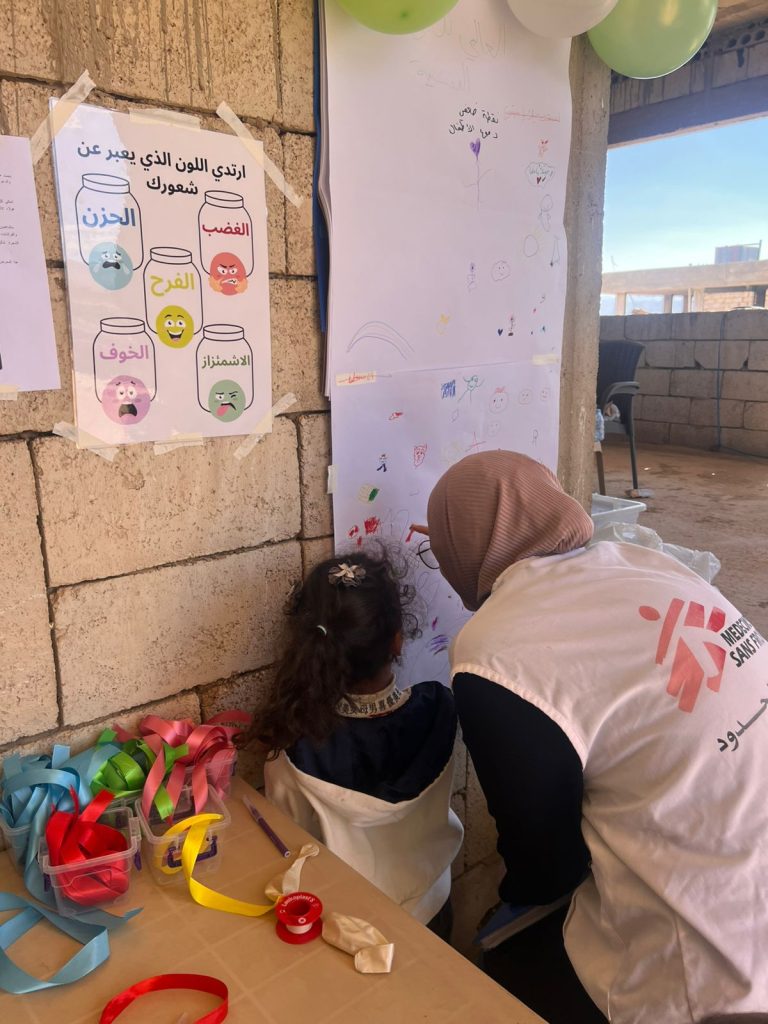
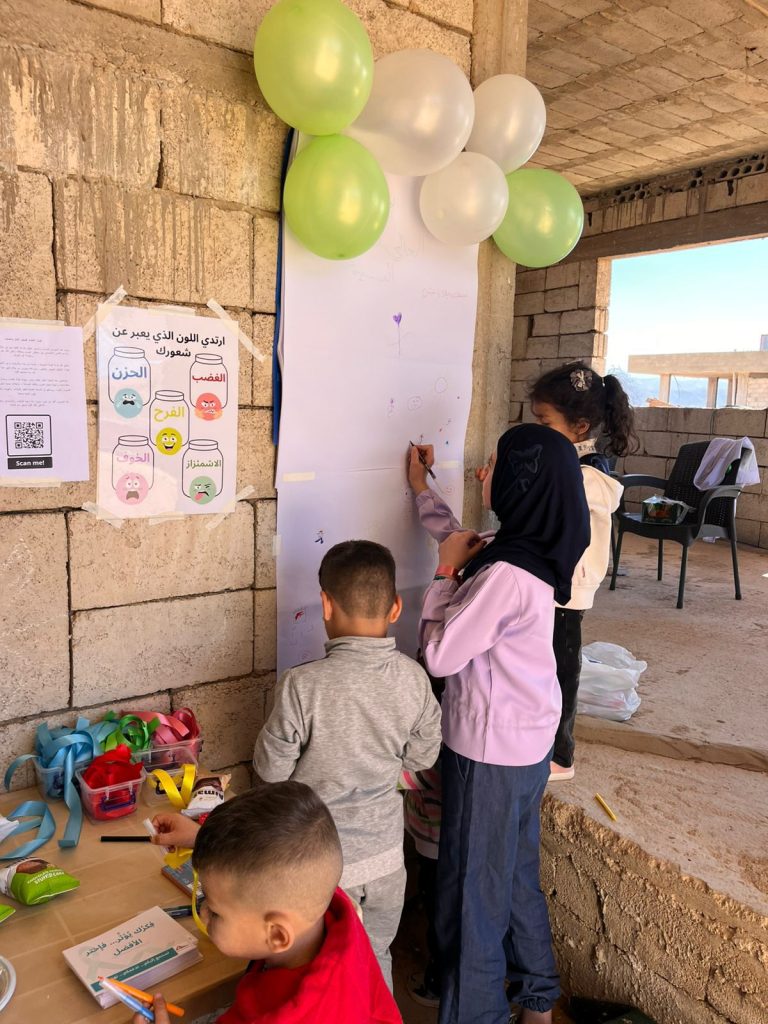
Our mental health teams began organizing regular drawing and art-based sessions in our mobile clinics and fixed facilities in Hermel and Arsal. The response was immediate: Each week, children arrived early and eager, some bringing crayons from previous sessions and others asking for extra paper to take home. What began as a simple activity quickly became a ritual: A space where they felt seen, safe, and free to imagine.
But what began as an activity to support the community quickly became a powerful window into unspoken struggles. The insight was staggering. As a psychologist, I looked beyond the drawings themselves, noting recurring, missing, or changing elements over time. These observations were considered alongside other information to inform our psychosocial support. Over time, the drawings told a story.
What drawings reveal about children’s psychology
Many children drew homes they no longer live in. These homes are often depicted larger, brighter, and more detailed than their current surroundings. Others drew trees, gardens, animals, and open skies. Taken together with the children’s words, their narratives, and the broader context of their experiences, these images reflect nostalgia, but not only for a place. They reflect a longing for safety, predictability, and belonging —feelings that war and displacement stamp out abruptly.
Nostalgia, in this context, is not simply about the past. For children, it serves a stabilizing role, helping them preserve a sense of identity amid disruption. Drawing familiar scenes allows them to reconnect with memories of care, family, and stability, all of which are essential elements for emotional regulation and resilience.
At the same time, other drawings included imagery often associated with fear and hypervigilance: drones in the sky, men carrying guns, dark clouds, or divided spaces. These images often appeared alongside peaceful scenes, showing how trauma and hope coexist in a child’s internal world. This duality is common in children affected by conflict — they are not only “victims” of fear, but also actively making sense of overwhelming experiences trying to integrate overwhelming experiences.
One drawing that stayed with me was made by Hamida, a 13-year-old girl from Syria. She drew a large mulberry tree and told us about her father shaking its branches while she and her siblings gathered the fruit beneath it.
The Tree We Left Behind
“This is our big and beautiful tree in the village that we left when we came here. I loved it because it had very tasty mulberries. My dad would shake the tree, and my siblings and I would run to collect them from the ground. There were flowers and land planted with onions near the tree. For sure, the tree must be dry now.“
By Hamida, 13 years old
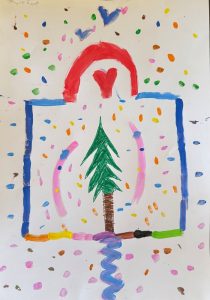
From a mental health perspective, Hamida’s drawing and its accompanying story and context hold multiple layers of meaning: connection to a caregiver, sensory memory, play, and loss—all contained within a single image. For Hamida, sharing this memory aloud was not only storytelling; it was emotional processing. The drawing allowed her to externalize grief in a way that felt contained and supported.
We have seen the positive impact of these drawing sessions. Parents tell us their children sleep better, speak more openly, or show fewer behavioral outbursts. Caregivers begin to understand that a child’s “misbehavior” may be linked to distress rather than disobedience. In this way, children often become quiet agents of change, reshaping how families think about emotions and mental health.
Baalbek-Hermel is a region of striking beauty and resilience, but also one that has absorbed years of hardship. People here are generous and welcoming, yet pain is often kept private. Mental health struggles are still surrounded by stigma, and many people seek help only when distress becomes unbearable.
Through simple, creative psychosocial support interventions like drawing, our teams create entry points—simplified ways to talk about mental health that feel accessible and human. These spaces allow both children and adults to understand that distress is not a personal failure, but a normal response to abnormal circumstances.
In Baalbek-Hermel, these drawings are more than images on paper. They are evidence that even in the aftermath of loss, children continue to imagine, remember, and hope. And sometimes, giving a child a crayon is not a small gesture at all: it is the first step toward being heard and chipping away at the wall stigma built.
Glykeria Koukouliata is a psychologist from Greece who joined MSF in 2023. She has worked on missions in Sudan, Armenia, Ethiopia, and lately in Lebanon. Originally preparing to become a lawyer, Glykeria’s path changed when she met a psychologist and saw how deeply people were drawn to her empathy and presence. Inspired by that connection, she decided to pursue psychology instead.
Today, Glykeria’s work focuses on providing mental health care and psychosocial support to communities affected by displacement and crisis—helping people find strength and healing even in the most challenging circumstances.
-
Related:
- Conflict in Lebanon
- Lebanon
- MSF in Lebanon