

I have spent most of my life as a refugee. The first time I ran from Burundi was in 1996. I was just a child then, and finally settled in Muyogozi in Kasulu, Tanzania. Later, we moved to Mutabila camp, where we stayed until 2012, when refugees were returned to Burundi. We thought the nightmare was over. We were wrong, and in 2015, unrest forced us to flee once more. Tanzania welcomed us again, and we passed through Nyarugusu camp, where the UN Refugee Agency (UNHCR) and partner organizations provided food, healthcare, and support that allowed us to start rebuilding our lives. This time, arriving at Nyarugusu camp, the fear was sharper because I knew what it meant to lose everything twice. But it was in that second exile that I found my true mission.
Shortly afterward, I applied to Médecins Sans Frontières (MSF). By June 2015, I was working at a health center Nyarugusu camp. In October, MSF selected six Burundian staff to help establish services at the newly opened Nduta Camp, and I was among them. We arrived in October, starting with a single clinic to assist newly arriving refugees. Within weeks, the organization expanded services, renovated hospital buildings, and increased staffing to meet the growing needs of the camp. As refugees arrived, I stood ready to help receive them. My own journey of flight ended the moment my work began.
I have rotated across services over the years, from maternity to pediatrics to the adult ward, and back to maternity in 2024. Throughout this time, I have been supported by supervisors, colleagues, and mentors. Today, I am a Nurse Aide in the busy maternity ward. The collaboration and mutual respect we share make the work meaningful, and the gratitude from patients is deeply motivating. There is a quiet satisfaction in knowing that the lives you touch are better because you were there.
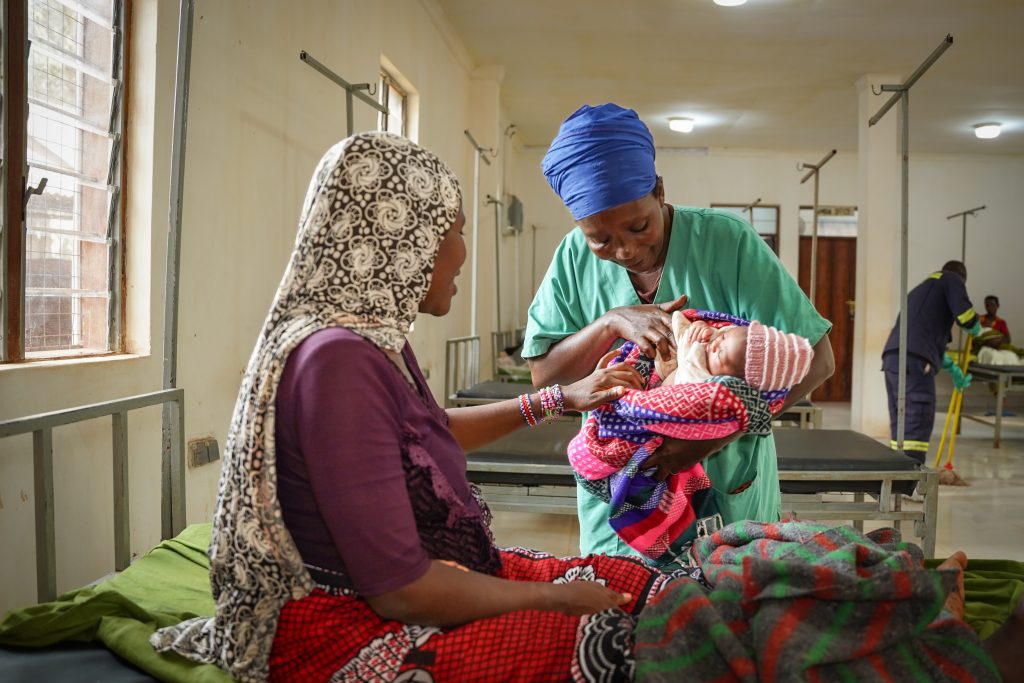
Working with children has always been my greatest joy. I spent several years in pediatrics, and there is something magical about the way a child responds to care. With adults, improvements can be slow and hard to see. But with children, even small progress is visible: a smile, laughter, playful energy. That immediate, pure joy reminds me every day why I chose this work. Of course, not every day is perfect. When a child’s health fails despite our efforts, it is painful. That is part of the reality of this job; success and setbacks are both constant companions. These are the moments that have defined my life for the past ten years at Nduta Refugee Camp.
For us, working with MSF is more than a salary, it is dignity. It is an anchor against the sea of anxiety that defines life in a camp.
We receive essential aid, but it can only stretch so far. This work has helped me as much as it has helped others. It allows me to provide for my family, supplementing the support we receive as refugees. The little income I receive helps us buy clothes for my children, change up our diet from the usual rations, and acquire simple things like soap or salt that are often missing.
Crucially, it gives me the means to help my neighbors. When I have a little extra, I can share with a fellow refugee who completely lacks something simple, like salt or matchsticks. That simple act
of cooperation and giving brings happiness to my heart. It reduces the stress of uncertainty and allows me to focus on the care of others.
If I did not have this work, I would often be stuck at home, consumed by the constant sadness and uncertainty of lacking, which would only intensify my anxiety.
As Nduta Refugee camp celebrates ten years, it is a testament to the resilience of our community. For MSF, whose work in Tanzania stretches back to the 1990s, I hope they continue to provide these crucial services and to empower more refugees like me. We are not just survivors, we are the hands that rebuild life, one safe delivery at a time. The good reputation MSF has in the community is well-deserved.
Over ten years, I have also built friendships with Tanzanians, fellow refugees, and people from other countries. Together, we have formed a supportive community where cooperation and trust are vital. That community, that sense of belonging, is one of the greatest gifts of my work. Watching mothers deliver safely, seeing babies thrive, and witnessing the relief and happiness of families these are the rewards that no material benefit could replace.
I tell myself, “I didn’t waste time doing this job and going to school.”
As I reflect on my decade here, I see not only the difference this work has made in the lives of others, but the difference it has made in mine. Every smile, every healthy delivery, every word of thanks is a reminder of why I chose this path. In a world that often feels harsh and uncertain, I have found purpose, community, and hope in the corridors of Nduta Camp.
For me, this is more than a job; it is a calling. Ten years later, I am proud to be part of the story of Nduta, proud to be a nurse aide who has witnessed courage and resilience at every turn.
MSF has a long history in Tanzania, responding to refugee crises and providing essential healthcare. From the 1990s to 2015, MSF assisted hundreds of thousands of refugees from Burundi, Rwanda, and the Democratic Republic of Congo, providing medical care, nutrition, and sanitation support. After scaling down once camps closed, MSF returned in 2015 to respond to a new wave of 400,000 Burundian refugees, establishing Nduta Camp in Kibondo District. Over the past ten years, MSF, in collaboration with the Ministry of Health, has provided primary healthcare, maternal and child care, mental health and psychosocial services, disease outbreak response, and health promotion programs. Nduta Refugee Camp has a population of 56,000 refugees.
-
Related:
- MSF in Tanzania
- tanzania