

Warsaw – As legislators in Poland draft a new law aimed at combatting human trafficking, Médecins Sans Frontières (MSF) urges that any measures inscribed in the legislation must not harm children. Children who are migrants are currently exposed to unreliable and inappropriate medical screening methods to determine their age. MSF calls on law makers to reject these methods as part of the law, and to ensure that ethical, comprehensive, and holistic means of assessing a child’s age are included.

A new MSF report, Age as a verdict, written with partners Save the Children and We Are Monitoring, looks at how age‑assessment procedures currently used in Poland are at risk of being formalised in the new law as part of the victim‑identification process. However, these procedures – including dental and radiological methods – are not scientifically reliable and are unethical for use in this context, in addition to carrying significant risks for children. Using these procedures to determine a minor’s legal age leads to harmful consequences; they can be unlawfully denied entry into Poland, and therefore protection and safety.

In the past, we were notified about young people who, shortly after undergoing an age‑assessment test, had been pushed back to Belarus directly from hospitals, still wearing casts and bandages. No-one should be denied care or pushed back from a hospital because of a medical test that was never designed to determine a person’s legal status.
Dr Alice Silvestro
MSF medical coordinator in Poland

The proposed law, “National Action Plan Against Trafficking in Human Beings”, is planned to enter into force no later than 2027. It comes as the government suspended the right for people to seek asylum in Poland in March 2025, and was supposed to be temporary – exceptionally introduced in response to an influx of people along the Polish-Belarusian border – yet it remains in force today. The suspension for seeking asylum does not apply, however, to some groups of vulnerable people, including unaccompanied minors. But there is no effective mechanism for identifying people belonging to those vulnerable groups, including children.

Over the past years, MSF teams providing medical support to asylum seekers in Poland have repeatedly observed the ineffectiveness of age assessment procedures, particularly on unaccompanied minors at the border with Belarus.

“We’ve seen children having to undergo harmful methods of age assessment to prove that they are not adults, to avoid being sent back to Belarus,” says Dr Silvestro. “These procedures have included using ionising radiation, which is not only scientifically unreliable, but it also goes against the fundamental principle of acting in the child’s best medical interest.”

In the case of minors, the initial need to recognise them as individuals under the age of 18 poses a significant challenge when someone does not hold a travel document, such as a passport. This lies within the discretion of officers when they apprehend someone at the border; and is particularly challenging in situations where this occurs in forests, without witnesses, under stress, and with language barriers.

Since March 2025, border guards in Poland have exercised even greater authority over determining a person’s path. They are the ones who decide whether someone is allowed to undergo the full age assessment procedure and apply for asylum. But we know these procedures are flawed; children must be protected rather than exposed to additional harm.
Uriel Mazzoli
MSF project coordinator in Poland

The Act on Combatting Trafficking may offer an opportunity to address these flaws and ensure that any future procedures prioritise child protection, scientific validity, and medical ethics.

“We call on paediatric radiology and endocrinology societies in Poland to take a position on age‑assessment practices and their scientific limitations,” says Dr Silvestro. “Standardised reporting guidelines and a clear affirmation of doctors’ right to refuse participation, without legal or professional repercussions, are essential to ensure ethical and effective methods, and safeguard children’s rights.”

Gaza: 1 in 4 young children and pregnant women malnourished amid Israel’s ongoing starvation policy

Israeli authorities’ deliberate use of starvation as a weapon in Gaza has reached unprecedented levels, with patients and healthcare workers themselves now fighting to survive, Médecins Sans Frontières (MSF) warns.

MSF staff are receiving an increasing number of malnourished patients at our clinics, while they themselves struggle to find sufficient food. Across screenings of children aged six months to five years old and pregnant and breastfeeding women, at MSF facilities last week, 25 per cent were malnourished. At the MSF clinic in Gaza City, the number of people enrolled for malnutrition has quadrupled since 18 May, while rates of severe malnutrition in children under five have tripled in the last two weeks alone.

This is not just hunger – it’s deliberate starvation, manufactured by the Israeli authorities. The weaponisation of food to exert pressure on a civilian population must not be normalised. Israeli authorities must allow food and aid supplies into Gaza at scale.
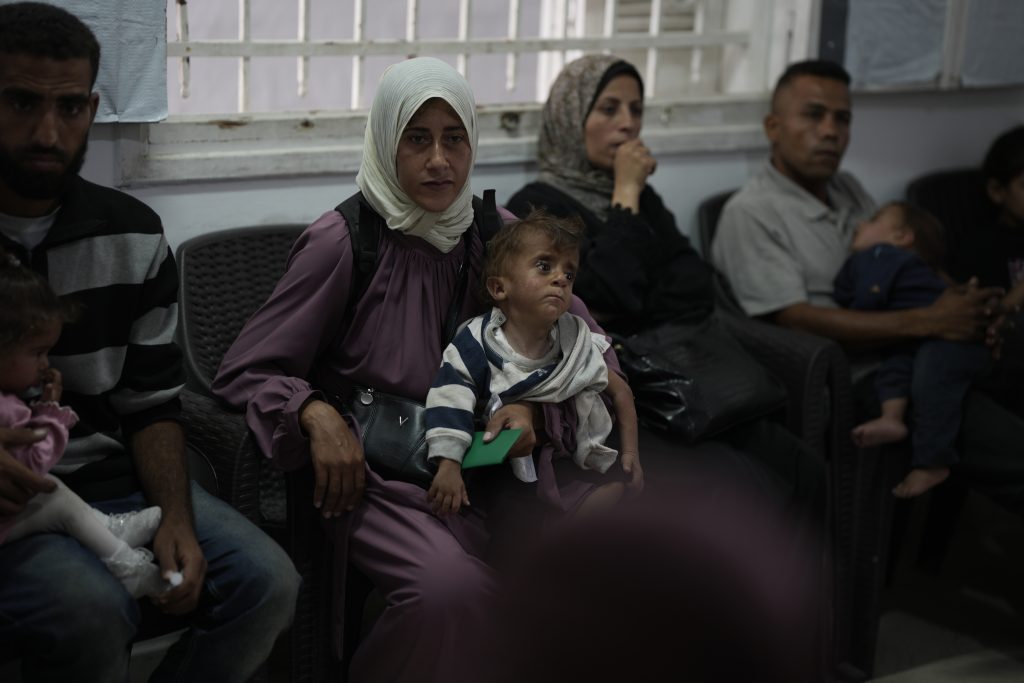
We see the dire consequences of these shortages in Gaza on a daily basis in our clinic. We are now enrolling 25 new patients every single day for malnutrition. We see the exhaustion and the hunger in our own colleagues.
Caroline Willemen
Project coordinator at the MSF clinic in Gaza City.
A Palestinian mother identified as Donia Alouf, 33 years old and her son 1 year old Ahmed, who was diagnosed with malnutrition. Donia receives medical assistance in Gaza clinic in Gaza city. She is 8 months pregnant, she herself is also malnourished. ©️ Nour Alsaqqa/MSF

Meanwhile, hundreds of people seeking desperately needed aid continue to be attacked by Israeli forces and private security contractors at food distribution sites run by the Israeli proxy, the Gaza Humanitarian Foundation (GHF).

What we are seeing is unconscionable; an entire population being deliberately cut off from food and water, all while the Israeli forces commit daily massacres as people scramble for scraps of food at distribution sites. Any shred of humanity in Gaza has been wiped out in the ongoing genocide.
Amande Bazerolle
MSF head of emergency response in Gaza

In the last two months, more than 1,000 people have been killed and over 7,200 injured, according to the Ministry of Health, as they attempted to collect aid, including a large proportion at the distribution sites of the GHF, which is backed and funded by the US government. Despite these sites being set up to avoid aid diversion, they have done nothing to reduce the existence of looting.

These food distributions are not humanitarian aid, they are war crimes committed in broad daylight and presented to the world with compassionate language. Those who go to the Gaza Humanitarian Foundation's food distributions know that they have the same chance of receiving a sack of flour as they do of leaving with a bullet in their head.
Dr. Mohammed Abu Mughaisib
MSF deputy medical coordinator in Gaza

In addition to people wounded at GHF sites, our teams have treated dozens of patients from recurrent massacres by Israeli forces as people wait for flour from trucks that pass by.

“In the emergency room of Sheikh Radwan clinic a few days ago, dozens of patients came in, both dead and wounded,” says Willeman. “These were people who had approached trucks for flour and were ruthlessly shot by Israeli forces.

That day MSF and Ministry of Health medical teams at the clinic, in north Gaza, treated 122 people with gunshot wounds who had been fired on while waiting for flour and additional 46 people were dead on arrival.

To make matters worse, in the last week, community kitchens who provide food to patients and medical staff in hospitals have struggled to do so, some shutting down for days at a time. Even if they can deliver, it is only one meal a day of plain rice for patients who need nutrient-rich food to heal properly, and often nothing for staff. This is no longer about what people can afford. There is barely any food available in most of the strip.




Show Buttons
Share On Facebook
Share On Twitter
Share On Linkedin
Contact us
Hide Buttons