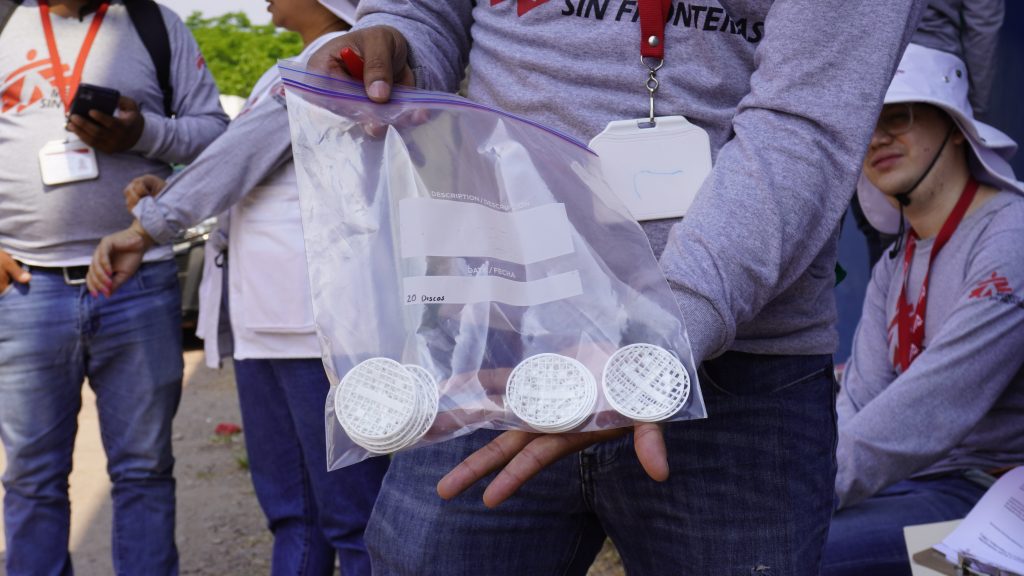
Doctors Without Borders/ Médecins Sans Frontières (MSF) has concluded our Arbovirus prevention project in Tegucigalpa, Honduras. This was an innovative initiative that combined science and community participation to reduce the transmission of dengue fever. While the activities related to the project finished in September 2025, the final scientific results are still being analysed. We expect to have these findings published in journals during the first quarter of 2026.
Launched in 2023, the project was implemented in collaboration with the Ministry of Health, the National Autonomous University of Honduras, the World Mosquito Program, the Metropolitan Health Region of the Central District, and local communities. Targeting the neighbourhoods of La Joya, El Edén, and El Manchén, it combined vector control methods such as Wolbachia-carrying mosquitos, indoor residual spraying, and pyriproxyfen disks on water wells, with strong community participation in all phases.
More than 8.5 million mosquitos were released carrying the Wolbachia bacteria in El Manchén, with 97.8 per cent prevalence of Wolbachia in the local Aedes aegypti mosquito population.
The dengue cases in El Manchén were significantly lower than expected, based on historical trends between this area and control areas that did not receive Wolbachia-carrying mosquitos. Statistical analyses suggest that the introduction of Wolbachia may have contributed significantly to this reduction in the incidence of dengue in El Manchén during last year’s outbreak.
7,500 households were reached through spraying and water well interventions in La Joya and El Edén.
This project demonstrates that innovation and community participation can go hand in hand in the fight against vector-borne diseases. It was a unique project within MSF globally, leaving us with valuable lessons in prevention and public health.
Edgard Boquín
MSF Project Coordinator
Although the prevention project has concluded, we maintain our commitment to the health of communities in Honduras through our sexual and reproductive health project in San Pedro Sula, ongoing epidemiological monitoring of dengue and other Arboviral diseases, and preparedness strategies for potential emergencies.
Like many websites, MSF uses cookies to enhance your user experience. By continuing to navigate this site you are giving consent to the issue of these cookies. No, give me more info
This website uses cookies to improve your experience while you navigate through the website. Out of these cookies, the cookies that are categorized as necessary are stored on your browser as they are essential for the working of basic functionalities of the website. We also use third-party cookies that help us analyze and understand how you use this website. These cookies will be stored in your browser only with your consent. You also have the option to opt-out of these cookies. But opting out of some of these cookies may have an effect on your browsing experience.
Necessary cookies are absolutely essential for the website to function properly. This category only includes cookies that ensures basic functionalities and security features of the website. These cookies do not store any personal information.
Any cookies that may not be particularly necessary for the website to function and is used specifically to collect user personal data via analytics, ads, other embedded contents are termed as non-necessary cookies. It is mandatory to procure user consent prior to running these cookies on your website.