
Farzana’s Journey
Farzana, 30, from Faryab province, northern Afghanistan, arrived at the MSF-supported Paediatric Intensive Care Unit at Abo Ali Sina Hospital in Mazar-i-Sharif, Balkh province, with her four-month-old son, Umar. Their journey had been long, filled with uncertainty, and marked by desperate attempts to find the right medical help.
The constant moving from one hospital to another took a toll on Umar’s health. Farzana describes how his condition worsened as they searched for care. By the time they arrived at Abo Ali Sina Hospital, Umar’s situation was dire.
“By the time we brought him here, he was in a very bad state. His skin had turned blue, and he couldn’t breathe. He was almost dead. He had stopped breathing, and the doctors immediately put him on oxygen. His chest was rising and falling heavily. He was in such a bad state that I thought he wouldn’t survive,” Farzana recalls.
At that point, Farzana felt utterly helpless. The weight of the situation hit her hard, and she even fainted from the stress.
“I felt terrible. I didn’t know what to do. When I looked at him, I thought he wouldn’t recover. Both my husband and I were in a very bad emotional state. We had no hope because two hospitals had already turned us away,” says the mother of Umar.
However, after 23 days at the hospital, Umar’s condition has improved. Initially requiring 17 litres of oxygen just to breathe, he now only needs 2 litres.
“Now, he is doing better. His color has returned, and he can drink milk from his mouth, something he couldn’t do before,” Farzana says with a sigh of relief. The emotion in her voice reflects the immense relief she feels as her son begins to recover.
Looking at Umar, now showing signs of improvement, Farzana feels hope again.
“Now that my baby is getting better, I feel happy again. I am very grateful to the doctors and nurses. They really worked hard to save him,” says Farzana.
For patients in critical condition, an effective and well-coordinated referral mechanism is crucial to ensure timely access to higher levels of care. However, in Balkh province the referral pathways are often weak or dysfunctional. Many healthcare facilities lack the necessary resources, transportation, or communication systems to properly refer patients to secondary and tertiary hospitals, which can delay lifesaving treatment.
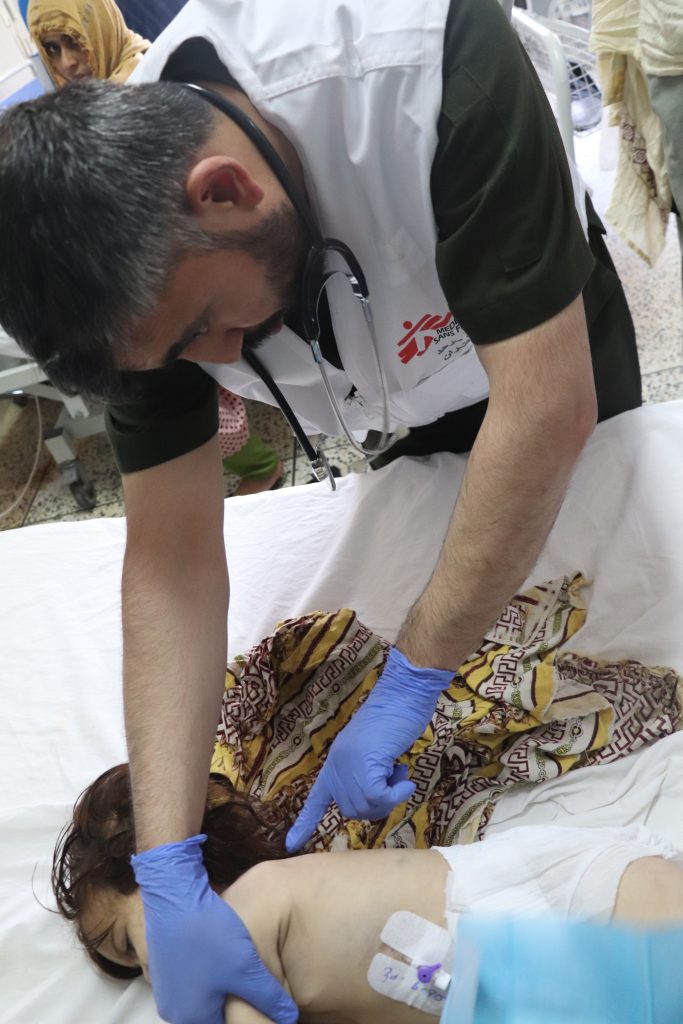
Asma recovering from Critical Condition
Ayesha, 25 years old, from Dawlatabad district in Faryab province, arrived at an MSF-supported health facility in Mazar-i-Sharif with her one-year-old daughter, Asma. The young mother’s journey to find proper care for her child was long and filled with uncertainty.
When Asma first became ill, her mother shares that her symptoms were worrying. She began vomiting and developed diarrhea. Soon after, her legs became swollen, and she showed signs of severe anemia.
Without proper guidance or structured referral between health facilities, Ayesha was forced to move from one doctor to another, trying to find answers. This delay in reaching specialized care worsened her daughter’s condition and put Asma’s life at greater risk. A functional referral pathway ensuring timely transfer from primary to advanced healthcare centers could have helped her receive appropriate treatment much earlier and possibly prevented her condition from becoming so severe.
“The laboratory tests revealed that Asma’s cholesterol and triglyceride levels were alarmingly high her triglycerides exceeded 1,200, while the normal level is below 200. The medical team continues to monitor her closely as they work toward a final diagnosis. For now, her condition is stable”. Says Dr Mohammad.
Despite the exhaustion of repeated hospital visits and financial strain, Ayesha’s focus remains steadfastly on her daughter’s recovery. “All I care about is that my daughter gets well,” she says quietly, holding Asma close.